Posted in Craft of writing, Creative Nonfiction Narrative, Details in Writing, Fiction & Nonfiction Writing, How to Write Emotional Beats, Metaphors, Reflection, Writing exercises

3 Enhancing Elements for your Stories and Essays

Metaphor of Women’s Dress Styles to our Writing 

Let’s explore that metaphor of women’s wedding attire to our writing. It struck me as useeful as I ruminated on women’s style of clothing today after attenting a wedding. 

A lot of stylish women showed off their figures in form-fitting dresses, both short and long at a family wedding recently in Phoenix. Regardless how one fit into herdress, in my humble opinion, some were too skinny for the style they wore and some were out of proportion (top heavy or bottom heavy) to select the style they had on.

Many wore a long dress, tucked in around their heels that made them scoot, shuffle, or skate across the floor, therefore, losing their natural walking gait. 

Let’s apply the form-fitting dress to our writing, whether it is travel writing or any other genre.

Too Skinny

Some women were too skinny and didn’t give shape or meaning to wearing a stylish dress. We can write skinny with not enough meat on the bones — too tight, too lean, too emotionless or meaningless.

  1. We need to flesh out our stories or essays by using our senses to illustrate what’s happening, where in the world we are, and how the action is taking place. Sensory details add depth and fullness to our stories.
  2. We can add emotional reaction to the events of the narrative or essay. We can alson reflect to what’s going on. How does it impact the key character(s)?
  3. We can also give heft, shape, and meaning by using an appropriate metaphor that runs the gamut of the story or one that gives weight to a single event. 

Too Out of Proportion – Top-heavy or bottom-heavy

We can also write out of proportion. Maybe one woman was too busty for her form-fitting dress, while another had little or no shape to her booty or legs. Maybe our stories start out strong and fizzle to no meaning at all. Perhaps our essays are overpowered by too many details so readers get lost in the tangle and wonder which ones are significant. Perhaps our writing carries too few details that leave the reader confused or wondering what’s what. Maybe our essays offer enough “leg” to carry the story line or plot, but without sufficient heart or emotion.

Just Right 

Then there’s the woman with the form-fitting dress that carries it off to perfection. Her makeup is understated, while only the flare of her cheeks and lipstick match the depth of the magenta color of her dress. Just off-the-shoulder neckline reveals the shape of her bustline, but no cleavage.

The tautness of the dress reveals the lovely shape of her hips, but never distracts one by the line in the crack of her booty, like some of the others I saw that night. Instead, it draped to the ground, loose enough for her to walk gracefully. The dress left room for the imagination.

Just like our writing. The wow of style applied in this extended metaphor to our writing offers guidance without a set of how-tos or step-by-step instructions.

The writer must flaunt the form, the function, and color of the writing with flare. Reveal the stunning details, the flow of events, the emotions and reflections on the events, so the reader has enough to keep her or him riveted and enough room to imagine and reflect on its meaning. Balanced.


This metaphor of women’s attire to our writing, nevertheless, advises the writer … 

  1. to find balance in the details of people, places, and events;
  2. to express emotions and reflection to enhance meaning; and
  3. to expand a metaphor to allow the imagination of the reader to explore and discover.

EXAMPLE #1-Not so good.

The  palm trees grew out of dirt with no sustaining grass to hold them in place. The city of Phoenix the surrounding mountains in the distance were khaki-colored, not lush green. The moon was covered by a palm fromPhoenix, AZ April 2025 where I stood. 

I was from another part of the country and Phoenix disappointed me without green grass and blooming flowers in mid-April. The wedding of my nephew to his finance seemed like the surrounding environment should be fresh, green, lush, and blossoming.

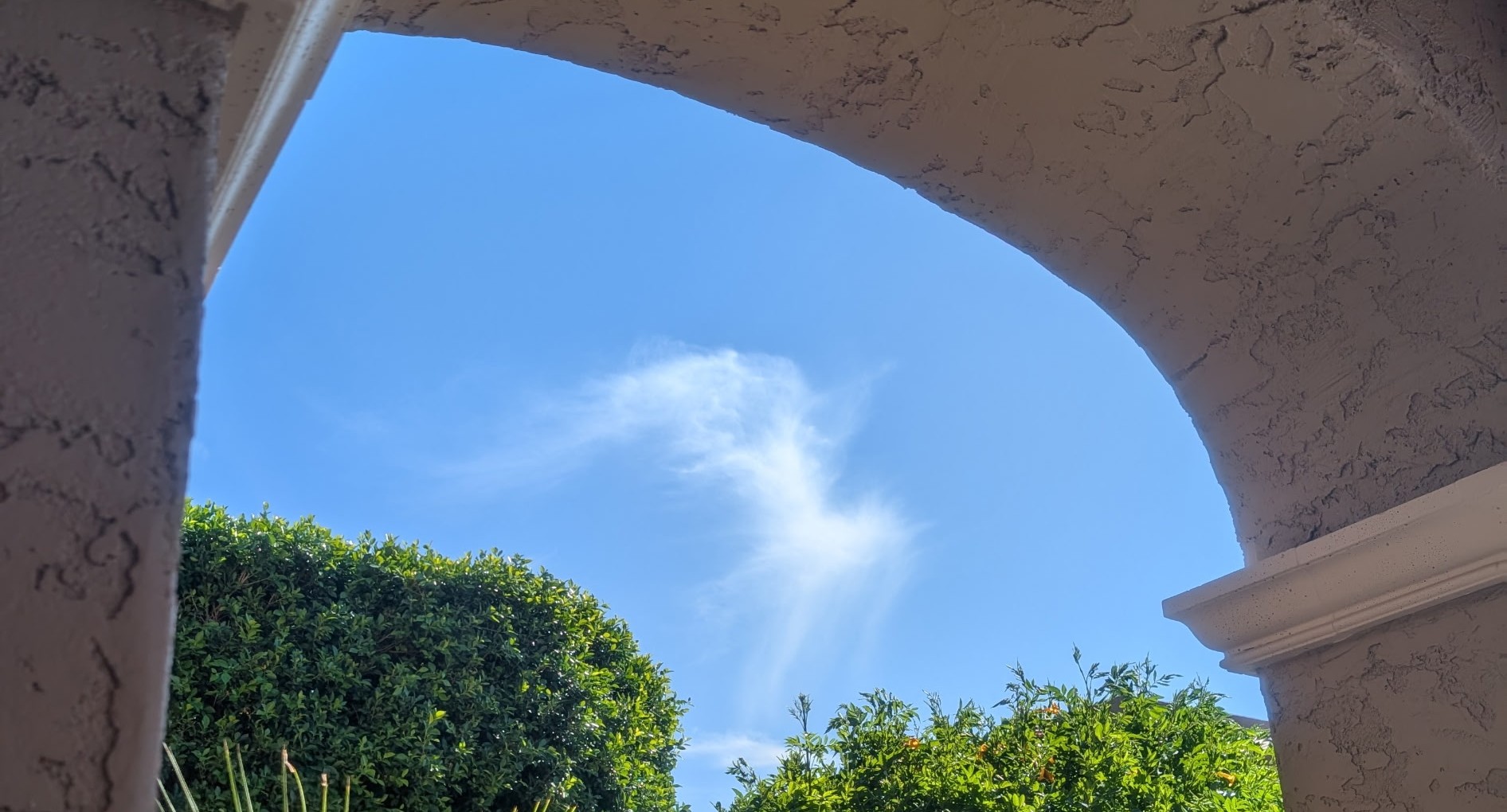
The clouds, flanked by an archway, made a phoenix shape in the sky. That’s the metaphor I wanted for the couple.  Rebirth, becoming something new. Resilience, the ability to overcome. Transformation, the openness to becoming someone different as a couple, as parents, as a family unit.

NOTE: No strong sense of place, peope, or events. Little reflection. And the metaphor is too obvious. Uninteresting. 

EXAMPLE #2-Much better

My nephew Dean, the groom, and the likeable and genuinely spirited young woman, Carson, would rise toPhoenix, AZ April 2025
promise their love and devotion to each other for a lifetime tomorrow.

The Phoenix palm trees rose tall and regal but seemed lonely in the bare dirt floor that stretched over the city and into the surrounding mountains. A palm shielded the full moon from where I stood. Dry, barren desert did not represent what the couple meant to me.

As I sat and visited with my brother Bruce, father of the groom, I noticed a cloud in the shape of a Phoenix, over his shoulder. It stretched out in a forward, mounting motion, as if reaching for the next adventure. The archway behind my sibling framed the cloud for the photo I took.

The new couple would soar too, like the Phoenix. They would experience a rebirth and new beginning from two individuals to a single couple into a family unit; resilience, the strength to overcome adversity together and grow stronger; and the hope of shining brighter together than ever before and the years soar by. Rising!

NOTE: Here you have the metaphor without calling it that. It’s more organic. There are more details and people’s names making it personal. This story is more compressed leaving only the necessary details. And in this short essay you move with the writer though the experience and land on the reflection that the couple will soar and rise, much like the Phoenix. 

When we pay attention to add these 3 elements to our writing we take it to the next level.  Share a piece of writing with us to show how you used these elements to allow your writing to soar! 

___________________________________________


Posted in adventure, Awe, Details in Writing, Mindfulness, Paying Attention

3 Simple, No-cost Ways to Pay Attention

Is This You?

Are you the last one in a group out for a walk to notice what’s happening in the environment? Are you the one who says, “What? Where is it? I don’t see it?”

  • Do you want to be the one who notices?
  • Do you wish to immerse yourself in the inexplicable?
  • Do you yearn to find the mysterious and clandestine elements in life?
  • Do you ache for the freedom of release and relaxation from feeling awe?
  • Do you believe you can experience the “ah!” in nature or the “awe?”

Paying attention is a habit, not some sophisticated study, though it can be.

Bird Watching Was My Starting Point

Once upon a time, I was one of those who wanted to be adept at experiencing the ineffable.

I took up birding, purchasing the Golden Guide to Field Identification: Birds of North America. Sure, I knew my birds, a robin, cardinal, and blue jay. I was familiar with the basic sparrow that was everywhere. But I did NOT know how many variations of sparrows there were until I started studying the book. Oh my goodness!

My First Identification

I observed a small grey bird with a white, round belly, which I’d never seen before. (Or had I seen it but not noticed it?) I saw it pecking in the snow in Wisconsin where I lived at the time. It looked like its belly had been dusted by snow. So in my mind I called it a snow bird, and so it is called by other birders. But in fact, it was one of the many kinds of sparrows listed in the bird book, called the slate-colored junco. Never had I heard of a junco.

A Friend Tried to Dissuade Me

A friend of mine suggested I study vegetation, flowers, trees, wildflowers – anything that didn’t move like birds that flit from limb to limb. She said, “Why don’t you decide to identify things that sit still, instead of birds that you have to follow around in a screen of leaves? Learn the skill of observation first?”

I was determined. “I’m not interested in those, but I’m in love with birds.” She shook her head and threw up her hands. “Okay. Start the hard way.” We laughed together.

Your 3-Step Guide to Paying Attention

For those of you who want to build observation skillls to pay attention, I suggest 3 simple ways. They come from a song most of us have heard before. Three ideas from a 1990s British TV children’s show, Come Outside, along with the theme song by the same name. Here, I want us to use these unpretentious words to the theme of the kids’ show:

Look up, look down, look all around.

STEP 1: LOOK UP

Yesterday, my three friends and their four dogs including Murphy and me had a brief 2–3-minute walk in a shower.  I looked up to see a rainbow in full display. Not horizon to horizon, but the vivid color spectrum grew out of a cloud. It sailed across the blue expanse and ended abruptly mid-sky. 

Jim Putnam's photo during an evening walk in the rain
Pay attention by looking up to find treasures in the sky.  

Layla said, “Make a wish. A rainbow is good luck. Look at the end of the rainbow and make a wish.” For me it was more of a prayer than a wish, “Make my husband Lynn stronger after cancer radiation.”

None of us, except Jim had a phone. “Jim, take a photo.” I was thinking of another post on paying attention when I repeated the request he had not heard. “Jim, please, take a picture. Send it to me.”


STEP 2: LOOK DOWN

Also yesterday morning as I walked Murphy home, I sensed movement in the grass. I looked down to two cicada killer wasps mating. They were end to end, vibrating as if they were enjoying it. I wondered whether without the emotions of a human, how they experienced the act of mating. One of the two had its face burrowed beneath the grass. Its stinger end attached to the other one hovering over the top of the grass. (After a web search, I learned the female has the stinger and the male does not.)

It was a moment for me. Was I interrupting? No, they did not notice me taking pictures of their intimate act. Was I rude to take their picture? I don’t know. Nonetheless,  it did make my day to get to see nature at work, at play, creating life!

STEP 3: LOOK ALL AROUND

Again yesterday I lounged on the porch loveseat, where I could feel the breeze tickle my skin. The golfers on the course beyond my yard probably gawked or sneaked a peek at me scrolling on my phone, listening to a course online, reading a book, and of course napping. (I’m recovering from surgery and 2 procedures in less than 6 weeks – nothing life threatening, merely an annoyance.) All this for the healing process.

I don’t usually take this kind of time each day to sit on the porch and watch the geese and the squirrels coexist. Sniff the freshly cut grass or listen to the birds and the chimes clash. I do however notice the black cat slink by in its ritualistic daily walk about. When I look all around and take in the world with all my senses, there’s a relaxed sense that neutralizes the anxiety of the news and life.

See? Simple. No-cost. Sing the song as you start out to work, to pick up the kids, to garden, clean the house, or go out with friends. You can apply this song to any part of your life, travels, or writing. These 3 steps can enrich our lives in so many ways. 

WHAT ABOUT YOU?

How do you pay attention to the world around you? How does nature speak to you? While you go about your day, what shows itself to you? I, along with many others, I presume would like to know. Share your stories, your thoughts with us.

~~~~~~~~~~~~~~~~~~

Please check out my books on Amazon. After reading one, please leave a review. Thanks!

Song of Herself, a story of a young horsewoman in 1906 who travels to India to sell her uncles horses. It is not the journey she expected or wanted but gave her the chance to grow into her own skin.

At Home in the World: Travel Stories of Growing Up and Growing Away, my coming-of-age travel memoir that covers ages 10 to 27. It is the story of my church and my mom, wise beyond her own experience and ahead of her time, who encourages and prepares me for international travel opportunities. I become a world citizen  at a very young age and later in life leave home and the church that provided me growth opportunities.

Both stories hold that travel can offer chances that help us build personal, psychological agency by which we become the author of our own lives.


Posted in Craft of writing, Description, Details in Writing, Editing & Revision, Pacing, Travel Writing

Description, Detail, and Pacing

Research that Serves the Story

In my last post, I illustrated three places in my recent novel, Song of Herself, where research served the story well. Without it, there would not have been sufficient particulars to give credibility to the characters.

As writers, we must search for and offer just enough details to render the character believable, but not so much that it bogs down the pace of the story. That’s a fine line.

Four friends have commented on that fine line and how my story achieved that for them as readers.  Here are their words.

Rhonda has taken years to craft this story and the work shows. One of the best books that I’ve read. The image of “monkeys swinging from thought…” sticks with me the most. (George H.)

You captured me with including wonderful information about things outside my world. The vocabulary of the ship and the special “horse words” are a bonus, but not ones that get in the way. (Jane W.)

Calcutta, I was there fifty years ago. You nailed it. The story flowed—made it easy to read. (Bruce B.)

The horses, you got it just right, but not too much. (Lenell D. )

Tips for Writers

  1. As writers, we must remember that readers want a fast-paced story with specifics that tell the story without slowing it down. Two to three targeted details usually get the job done.
  2. Presenting them in the context of an appropriate environment helps, as well. To find how much time is spent in a scene and then match it to how the reader experiences the story is critical. This is called pacing.
  3. Writers develop the skill of pacing over time from experience and feedback by beta-readers or writing group members helps.

If you haven’t already ordered my book, Song of Herself, see below

Paperback: https://www.amazon.com/dp/1639885501

Ebook: https://www.amazon.com/dp/B0BDK7Q54J/

If you read the book, please leave a short review of two or three sentences on Amazon, what you liked, what you found intriguing, or what you discovered about yourself in reading the book. Thanks, so much!!!