Posted in Craft of writing, Creative Nonfiction Narrative, Details in Writing, Fiction & Nonfiction Writing, How to Write Emotional Beats, Metaphors, Reflection, Writing exercises

3 Enhancing Elements for your Stories and Essays

Metaphor of Women’s Dress Styles to our Writing 

Let’s explore that metaphor of women’s wedding attire to our writing. It struck me as useeful as I ruminated on women’s style of clothing today after attenting a wedding. 

A lot of stylish women showed off their figures in form-fitting dresses, both short and long at a family wedding recently in Phoenix. Regardless how one fit into herdress, in my humble opinion, some were too skinny for the style they wore and some were out of proportion (top heavy or bottom heavy) to select the style they had on.

Many wore a long dress, tucked in around their heels that made them scoot, shuffle, or skate across the floor, therefore, losing their natural walking gait. 

Let’s apply the form-fitting dress to our writing, whether it is travel writing or any other genre.

Too Skinny

Some women were too skinny and didn’t give shape or meaning to wearing a stylish dress. We can write skinny with not enough meat on the bones — too tight, too lean, too emotionless or meaningless.

  1. We need to flesh out our stories or essays by using our senses to illustrate what’s happening, where in the world we are, and how the action is taking place. Sensory details add depth and fullness to our stories.
  2. We can add emotional reaction to the events of the narrative or essay. We can alson reflect to what’s going on. How does it impact the key character(s)?
  3. We can also give heft, shape, and meaning by using an appropriate metaphor that runs the gamut of the story or one that gives weight to a single event. 

Too Out of Proportion – Top-heavy or bottom-heavy

We can also write out of proportion. Maybe one woman was too busty for her form-fitting dress, while another had little or no shape to her booty or legs. Maybe our stories start out strong and fizzle to no meaning at all. Perhaps our essays are overpowered by too many details so readers get lost in the tangle and wonder which ones are significant. Perhaps our writing carries too few details that leave the reader confused or wondering what’s what. Maybe our essays offer enough “leg” to carry the story line or plot, but without sufficient heart or emotion.

Just Right 

Then there’s the woman with the form-fitting dress that carries it off to perfection. Her makeup is understated, while only the flare of her cheeks and lipstick match the depth of the magenta color of her dress. Just off-the-shoulder neckline reveals the shape of her bustline, but no cleavage.

The tautness of the dress reveals the lovely shape of her hips, but never distracts one by the line in the crack of her booty, like some of the others I saw that night. Instead, it draped to the ground, loose enough for her to walk gracefully. The dress left room for the imagination.

Just like our writing. The wow of style applied in this extended metaphor to our writing offers guidance without a set of how-tos or step-by-step instructions.

The writer must flaunt the form, the function, and color of the writing with flare. Reveal the stunning details, the flow of events, the emotions and reflections on the events, so the reader has enough to keep her or him riveted and enough room to imagine and reflect on its meaning. Balanced.


This metaphor of women’s attire to our writing, nevertheless, advises the writer … 

  1. to find balance in the details of people, places, and events;
  2. to express emotions and reflection to enhance meaning; and
  3. to expand a metaphor to allow the imagination of the reader to explore and discover.

EXAMPLE #1-Not so good.

The  palm trees grew out of dirt with no sustaining grass to hold them in place. The city of Phoenix the surrounding mountains in the distance were khaki-colored, not lush green. The moon was covered by a palm fromPhoenix, AZ April 2025 where I stood. 

I was from another part of the country and Phoenix disappointed me without green grass and blooming flowers in mid-April. The wedding of my nephew to his finance seemed like the surrounding environment should be fresh, green, lush, and blossoming.

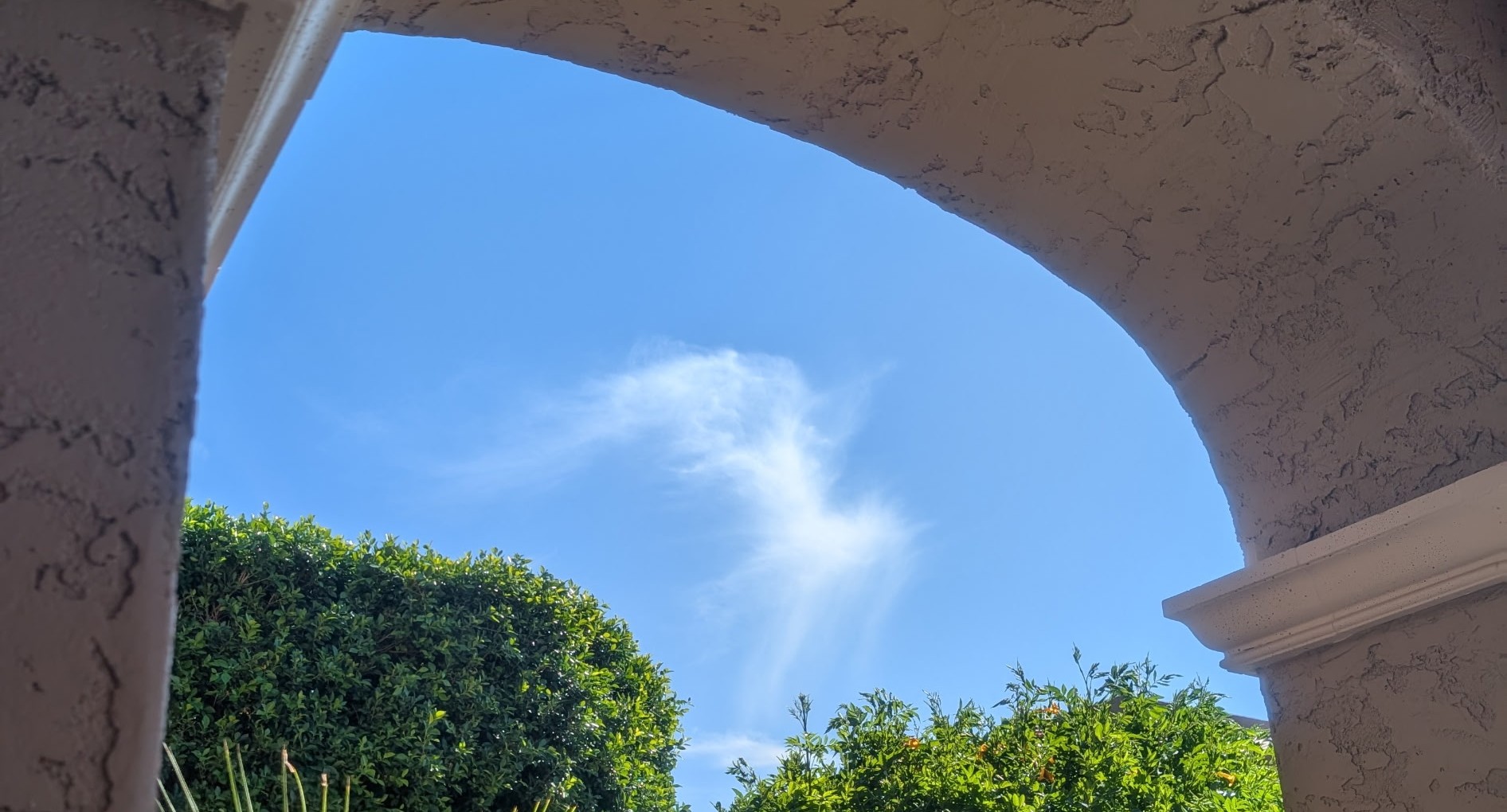
The clouds, flanked by an archway, made a phoenix shape in the sky. That’s the metaphor I wanted for the couple.  Rebirth, becoming something new. Resilience, the ability to overcome. Transformation, the openness to becoming someone different as a couple, as parents, as a family unit.

NOTE: No strong sense of place, peope, or events. Little reflection. And the metaphor is too obvious. Uninteresting. 

EXAMPLE #2-Much better

My nephew Dean, the groom, and the likeable and genuinely spirited young woman, Carson, would rise toPhoenix, AZ April 2025
promise their love and devotion to each other for a lifetime tomorrow.

The Phoenix palm trees rose tall and regal but seemed lonely in the bare dirt floor that stretched over the city and into the surrounding mountains. A palm shielded the full moon from where I stood. Dry, barren desert did not represent what the couple meant to me.

As I sat and visited with my brother Bruce, father of the groom, I noticed a cloud in the shape of a Phoenix, over his shoulder. It stretched out in a forward, mounting motion, as if reaching for the next adventure. The archway behind my sibling framed the cloud for the photo I took.

The new couple would soar too, like the Phoenix. They would experience a rebirth and new beginning from two individuals to a single couple into a family unit; resilience, the strength to overcome adversity together and grow stronger; and the hope of shining brighter together than ever before and the years soar by. Rising!

NOTE: Here you have the metaphor without calling it that. It’s more organic. There are more details and people’s names making it personal. This story is more compressed leaving only the necessary details. And in this short essay you move with the writer though the experience and land on the reflection that the couple will soar and rise, much like the Phoenix. 

When we pay attention to add these 3 elements to our writing we take it to the next level.  Share a piece of writing with us to show how you used these elements to allow your writing to soar! 

___________________________________________
 

Posted in Craft of writing, Fiction & Nonfiction Writing, Revision, Scene Craft

Two Types of Writing Research & Two examples of each

INTRODUCTION
Discovery in writing happens in so many ways. All the different ways can be enlightening to the writer and in turn for the reader. Discovery may happen before, during or after writing a chapter, scene, or essay. Some are technical such as dialogue that’s culturally relevant or time frame that matches with the attire of characters, while others are artistic, such as voice, rhythm, pacing, or description.

TECHNICAL RESEARCH
Example #1: I love working with all of these means of discovery. Research to know what is happening in a particular time will create interest and/or relevance. For example, when I write about the 1970s I need to know the pop culture of the time. Through music, world events like Vietnam War, social events of protests.

Example #2: When I write about Cuba, I need to know about the cars that line the streets. Writing about a Ford Bel Air, instead of accurately a Chevy Bel Air, will make my writing suspect. And what if only a few know the difference? They may be the ones who tell others every chance they get that I don’t know what I’m writing about. Therefore telling potential readers not to bother with my work. That’s a marketing blunder.

ARTISTIC RESEARCH
Example #1: On the other hand, discovering how I develop my voice on the page, how I pace different stories based on the demands of the story to be a slow burn or a rapid-melt conclusion, require learning from my own mistakes. Paying attention to what works with my writers’ community or beta readers is key to building my confidence and adherence to using my own voice in my work.

Example #2: Artistically as writers, we need to spend time reading great works and even not such great works to see what doesn’t measure up. We read to “feel” when a writer’s pacing reflects what is actually happening in the story. We read to “hear” how the words fall on the page and in our ears. Do they fit the era? Do they fit the timing of the story? Do they reflect emotions being expressed?

SUMMARY
Our lives as writers are always at work in our heads as to how to write. We can learn from overheard conversations, jokes, google searches, or library digging. What a wonderful job (full of wonder) we get to enjoy. But we must also do our own due diligence, to ensure that are work is relevant, inspiring, and culturally, technically, and scientifically accurate. Our work is never done and that’s the fun of it.

See my latest work: Song of Herself.

Fiona Weston, an Iowa horsewoman in work boots and trousers, sails to India in 1906 to discover her journey is not the quest for which she had yearned, nor the escape from those who ridicule her unconventional ways. Fiona experiences a journey fraught with obstacles that creates a sturdy sense of self in which she learns to accept irreconcilable differences and still sing her song of self.

It’s available on Amazon and Bookshop.

Posted in Craft of writing

Join the Story Circle Network Class, “What Lurks Beneath: Finding the Emotional Current Beneath the Story Events”

Invitation to Join the Class

For my writing friends, this is an invitation to join me and others to write a personal essay (travel writing perhaps?), then search for the emotional currents that lurk just beneath the events of the story. Learning how to express the emotional beats or currents in your story (whether fiction or nonfiction) challenges most of us as writers.

Class Description in a Nutshell

This class will explore the uniqueness of travel writing and how to revise and edit your work for publication word count limitations. Once the personal essay is drafted then you will learn how to discover the emotional current or force of you story, where to add emotional content, and different ways to express an emotional beat, like peeling an onion.

Learn More Here

I’d enjoy having you join us. You will find the class summary and outline with dates and costs, along with how to register for the class on the Story Circle Network’s class website.

Posted in Craft of writing

Join the Story Circle Network Class, “What Lurks Beneath: Finding the Emotional Current Beneath the Story Events”

Invitation to Join the Class

For my writing friends, this is an invitation to join me and others to write a personal essay (travel writing perhaps?), then search for the emotional currents that lurk just beneath the events of the story. Learning how to express the emotional beats or currents in your story (whether fiction or nonfiction) challenges most of us as writers.

Class Description in a Nutshell

This class will explore the uniqueness of travel writing and how to revise and edit your work for publication word count limitations. Once the personal essay is drafted then you will learn how to discover the emotional current or force of you story, where to add emotional content, and different ways to express an emotional beat, like peeling an onion.

Learn More Here

Please join us. You will find the class summary and outline with dates and costs, along with how to register for the class on the Story Circle Network’s class website.

Posted in adventure, Craft of writing, Debut Novel, fiction, Historical Fiction, Travel Writing, Women traveling, Women's Fiction

The Gold Standard of Book Reviews

I’m thrilled to share with you the book review I received from Kirkus Reviews just last week. Kirkus Reviews are the gold standard for anonymous, fair, unbiased book reviews. Many librarians use their reviews to determine which books they will purchase and shelve. See a partial review of Song of Herself, my debut novel.

… Wiley-Jones packs her narrative with a plethora of captivating themes and images that expose Fiona and readers to India’s cultures, religions, and styles (Women “wrapped their silhouettes with sarees in every color from ruby red to sapphire blue, and marigold to lemon yellow”) as well as the building Indian resentment toward British imperialism. Then there is the chaos of Calcutta, which the author describes in vivid detail, capturing the city’s history, topography, sounds, smells, and foods. Fiona is a complex character who repeatedly turns to Walt Whitman’s Leaves of Grass for inspiration and guidance in her search for her own center. …

… An engaging period drama overflowing with historical tidbits.

Consider buying a copy for a Christmas gift of the book, Song of Herself !

Paperback: https://www.amazon.com/dp/1639885501

Ebook: https://www.amazon.com/dp/B0BDK7Q54J/

Recently my friend Marge wrote me,

“I just finished your book and loved it. It was a page turner! I loved the character development and learned so much. All your hard work paid off! Thank you for the adventure. I loved the ending!!”

If you have read the book, please leave a short review of two or three sentences on Amazon.